

Analysis
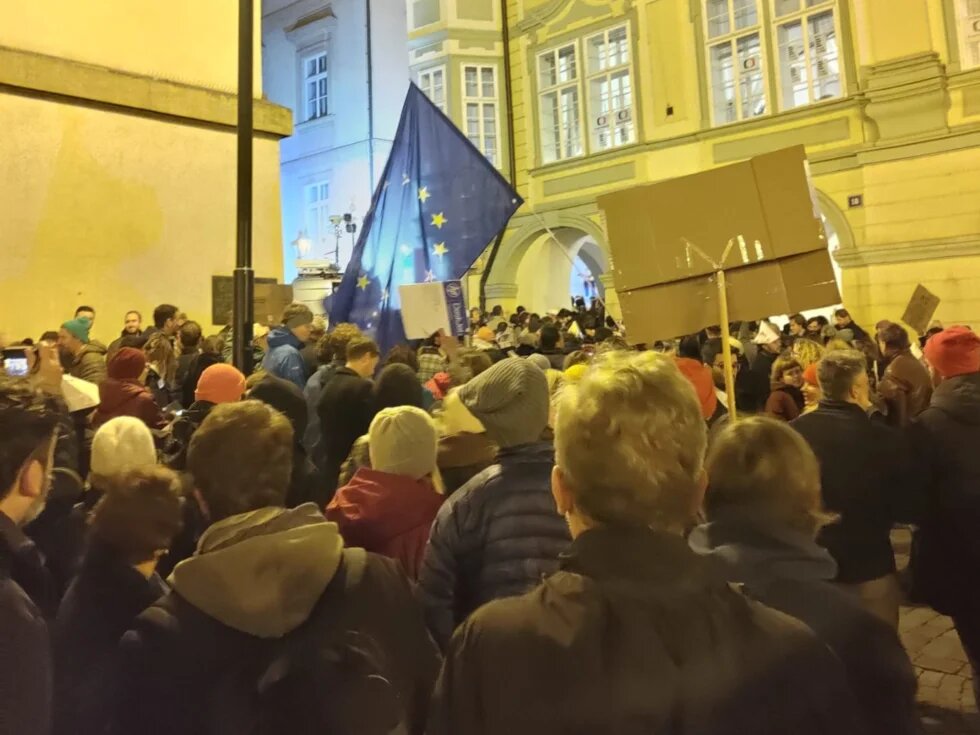
At 4:36 AM on Saturday, 23 October, when most people were fast asleep, the Czech Chamber of Deputies approved the first reading of a bill that would fundamentally change how public broadcasters Czech Television and Czech Radio are funded. Parliamentary votes at this hour are unusual; it is more commonly a time associated with things happening under cover of darkness – stealing, making arrests, or launching military invasions. The public response was even more remarkable. Tens of thousands of citizens have taken to the streets, students have organized protests, theatres have joined the demonstrations, and employees of both public broadcasters have staged a strike. What makes these protests particularly noteworthy is that people are standing up for a system in which they themselves pay a monthly licence fee.

What is at stake is not merely a funding arrangement, but the future of independent, adequately-funded public service media.
Czech public service media are often regarded as a success story in the post-communist region, with Czech Television (ČT) and Czech Radio (ČRo) occupying a central position in the country’s media landscape. Their reach and public standing are considerable: Czech Television commands the largest audience share in the television market, while Czech Radio’s main news station, Radiožurnál, is the most listened-to radio station in the country. The two broadcasters have also consistently ranked as the most trusted news sources in the Czech Republic, according to the Reuters Digital News Report. Beyond their news remit, they are major producers of original Czech content, including films, TV series, documentaries, children’s programmes, radio dramas and other audio productions. By offering an alternative to commercial and global content, they contribute significantly to the country’s creative industries and cultural life.
However, this strong position does not mean that Czech public service media enjoy universal public support. Criticism centres particularly on the perceived lack of objectivity and political bias in their news coverage, especially at Czech Television. More than a third of Czech citizens perceive political bias in its broadcasts, although views differ considerably over the direction of that bias, as we show in a study conducted in 2023 at Masaryk University. Negative attitudes towards public service media are more common among the voters of the governing coalition, particularly Action of Dissatisfied Citizens (ANO) and “Freedom and Direct Democracy” (SPD). While some criticism reflects genuine concerns about objectivity and balance, other critiques question the value of public service media altogether. This opposition is fuelled by political rhetoric portraying the broadcasters as biased, wasteful of public funds, and serving pro-Western, liberal, progressive urban elites. Such tensions intensified following the COVID-19 pandemic, when opponents of vaccination denounced public broadcast coverage as propaganda and accused these media outlets of suppressing alternative views. Czech public service media have thus become increasingly entangled in the country’s political and cultural divisions.
The Czech funding model: How the system works (so far)
ČT and ČRo, once state-controlled, were transformed into independent public service institutions in 1992, primarily funded through licence fees paid by households and companies. That revenue accounts for approximately 90% of their budgets.
The fees stayed the same for nearly two decades, however (the television fee had not been raised since 2008, the radio fee had not been raised since 2005). Inflation then eroded the purchasing power of this revenue, leaving the public broadcasters with increasingly constrained resources.
In May 2025, under the previous Government, Parliament raised the monthly public broadcasting fees by €1, bringing them to approximately €8.50 per month. The reform widened the payment obligation to include households using Internet-connected devices such as smartphones, tablets, and computers to access public broadcasting services. Automatic indexation was simultaneously introduced: once cumulative inflation exceeds 6%, the fees are increased by 6%. This mechanism is intended to protect the real value of public broadcasters’ income and reduce the need for repeated political negotiations over fee increases.
This reform may prove to be very short-lived, as the political context shifted just a few months later. In October 2025, Andrej Babiš’s ANO party won the parliamentary elections and the new Government proposed replacing the licence fees with funding from the public budget.
The proposed funding reform: What would change and what is at stake?
The proposed reform has changed considerably over time. What began as a plan for a new law on public service media was eventually narrowed to funding reform after the broader proposal faced substantial criticism during the inter-ministerial consultation process and was ultimately abandoned by the Culture Ministry. Even in its revised form, however, the reform would affect ČT and ČRo in two fundamental ways: it would change how they are funded and reduce the resources available to them.
The first change would replace licence fees with funding from the state budget, increasing the risks to the public broadcasters’ political independence, the adequacy of the allocated funds, and their long-term predictability. Politicians already determine the level of the licence fees, so the current system is not entirely insulated from political decisions. There is, however, an important difference. Licence fees are paid directly by members of the public, their amount is publicly known, and any increase or reduction is immediately visible to households. This visibility helps make changes politically sensitive and contributes to the system’s stability.
State-budget funding, by contrast, makes changes to public service media budgets less visible and more dependent on political priorities and the electoral cycle. Allocations could become more vulnerable when public finances come under pressure or governments face competing spending demands.
Public broadcasters could also become more cautious in their criticism of those who control their funding, anticipating that critical reporting could have financial consequences.
International comparisons lend weight to these concerns. A comparative study conducted by scholars from three Czech universities, which the author of this article coordinated, examined how public service media funding is regulated and works in practice across 13 European countries. It found that funding raised directly from members of the public generally provides stronger safeguards for political independence, adequacy, and predictability than state-budget financing. While state-budget funding can work in contexts with a strong tradition of political restraint, such as Norway, this cannot be assumed in Central and Eastern Europe. In this context, robust legal safeguards are particularly important to ensure public service media funding cannot be easily subjected to political discretion.
The second change would result in a substantial reduction to overall funding for the public broadcasters: the Government proposal envisages cutting their budgets by approximately 15-20%. The proposed inflation-adjustment mechanism would also gradually erode the real value of their already-reduced budgets. The consequences would be felt most directly in programming, putting original Czech productions, regional and investigative journalism, cultural and educational programmes, children’s content, and sports coverage at risk. The impact would extend to the wider creative economy, as ČT and ČRo are major commissioners and producers of domestic content and important partners for independent producers, the audiovisual industry, and other suppliers. The reform could reshape the Czech media market’s competitive balance. As public service broadcasters reduce their output and potentially lose audiences, commercial media and global streaming platforms should gain them. However, they cannot be expected to replace the content that public service media would no longer produce, given their different economic incentives and lack of an equivalent obligation to serve all audiences or invest in commercially unattractive content.
Ultimately, the concern is that the reform would leave ČT and ČRo more financially vulnerable, more exposed to political pressure, and less able to fulfil the responsibilities on which their public legitimacy depends. This could create a paradox: politicians would first substantially reduce the resources available to public service media, then question their very existence on the grounds that they no longer provide sufficiently attractive or relevant content.
The politics behind the reform: Why the rush?
The Government’s intention to abolish the licence fees came as no surprise. During the previous reform, ANO and SPD, then in opposition, strongly opposed the increase of just one euro per household per month and pledged to reverse it upon taking office. What has been unexpected is the way the reform was pursued. Introduced at short notice, the bill was approved in its first reading at 4:36 a.m. on a Saturday in an apparent attempt to pre-empt opposition obstruction and minimise public protest. The rush was interpreted as an attempt to divert attention from the governing coalitions’ disappointing results in local and Senate elections earlier in October.
The accelerated procedure featured an absence of meaningful debate and consultation. Neither the Culture Ministry nor the Government itself have ever established a working group on this issue despite repeated calls from ČT and ČRo, academics, media professionals, and other stakeholders to do so. Governing coalition representatives also ignored repeated invitations to discuss the reform at conferences and roundtables.
More fundamentally, the Government has failed to convincingly explain why the existing funding model needs to be replaced. Its main arguments—that abolishing fees was an electoral promise, that such fees are outdated, and that people should not have to pay for services they do not use—do not explain why the licence-fee model must end or why the proposed alternative would work better. Nor did the election promise include the proposed 15% budget cuts, which the Government put forward without even demonstrating that the public broadcasters are allegedly “overfunded”.
The proposed alternative fails to deliver on the claim that it would spare people from paying for media they do not use. Under state-budget financing, the public would still contribute through taxation, regardless of whether they use public service media.
The change would instead make such funding more dependent on political decisions and more costly, as it would increase public borrowing and debt-servicing costs.
Funding systems for public broadcasting are typically reformed either because the existing model no longer works, or because of populist pressures, or because political actors seek greater control over public service media. These motivations can overlap. In the Czech case, the lack of a convincing rationale, the refusal to engage in substantive debate, and the procedural haste, alongside long-standing criticism of public service media and attacks on individual journalists by governing coalition members raise suspicions that this reform is driven primarily by populist promises of savings and a desire to curtail the activities and content of media outlets disliked by those in power, with gaining increased political leverage over their funding an additional advantage.
A regional perspective: Lessons from Slovakia and Hungary
These developments in Czechia form part of the broader pattern of political challenges facing public service media across Central and Eastern Europe. Experiences in Slovakia and Hungary illustrate how changes to funding and governance can create opportunities for political interference, even when such changes were not initially intended to undermine media independence.
In Slovakia, the previous centre-right, pro-European coalition government abruptly abolished the licence-fee system in 2023 without public debate, replacing it with funding set at a statutory percentage of GDP. Just months after the reform took effect, Robert Fico’s party won the parliamentary elections, and his Government swiftly cut the statutory allocation from 0.17% to 0.12% of GDP. However, the Government did not stop there: it dissolved Radio and Television of Slovakia (RTVS), replacing it with a formally new organisation, Slovak Television and Radio (STVR). The dissolution of RTVS terminated the mandates of both its director-general and the members of its supervisory body, allowing the Government to appoint new leadership more aligned with its preferences. Personnel changes and dismissals followed, accompanied by shifts in editorial output.
Hungary under Viktor Orbán, whose long period in power ended in 2026, illustrates a more advanced stage of public broadcast media-system transformation. After taking office in 2010, his Government centralised public service television, radio, and the national news agency under a single structure, substantially reducing their organisational and financial autonomy and replacing their leadership with Government loyalists. Once political control had been consolidated, funding increased substantially. The transformation extended beyond public service media: pro-Government businesspeople acquired private media outlets, while independent media faced economic pressure, including through the discriminatory allocation of state advertising. The result was a media landscape in which both public service media and a substantial part of the commercial sector came under political influence.
Czechia’s public service media have so far avoided similarly far-reaching institutional and personnel changes. This resilience reflects several factors. Their long-standing position and public relevance within the national media landscape, combined with their strong track record of independence, have made them institutions the public has reason to defend. Robust, well-organised civil society further provides the basis for mobilising against political interference. The crisis at ČT in the year 2000, when public protests and a newsroom sit-in contributed to the resignation of the politically favoured director-general, remains a powerful illustration of the political costs of interference. It has also become a lasting precedent in the country’s political memory, helping deter similar attempts until now.
Nevertheless, regional experiences offer an important warning: political capture of the media does not necessarily begin with an explicit decision to transform public service media into state media.
In both Slovakia and Hungary, the shift from licence fees to state-budget funding was introduced by administrations not led by either Fico or Orbán, without an apparent intention to use the funding mechanism as a political weapon, yet those reforms created vulnerabilities which the subsequent, more hostile administrations could exploit. The Hungarian case also illustrates how funding can be instrumentalised either to weaken independent public service media through cuts, or to sustain and reward media when they are state-controlled. The Czech proposal to reduce funding for ČT and ČRo and shift it towards state-budget financing is consequential even in the absence to date of broader legislative proposals for institutional restructuring, therefore.
The Czech case also differs in that the European Media Freedom Act is now in force (unlike when Hungary and Slovakia undertook their major reforms). That law requires public service media funding to be based on transparent, objective criteria and for adequate, sustainable, predictable resources to be provided while safeguarding editorial independence. If the reform is found to breach these requirements, the European Commission could initiate infringement proceedings against the Czech Republic and, if the violation is not remedied, refer the case to the Court of Justice of the European Union. Although such proceedings are likely to be lengthy and cannot automatically prevent such reforms from taking effect, they may nonetheless provide an important source of political and institutional pressure.
Public pressure and the road ahead
If the Government intended to avoid public scrutiny by holding the vote on canceling the licence fees in the early hours of Saturday, it failed. The abrupt procedure brought the future of public service media into the public eye, including for members of the public who might otherwise have paid little heed to the issue.
The protests have been remarkable in both their scale and breadth. Public mobilisation began on the day of the surprise parliamentary debate, with people gathering outside the Chamber of Deputies and remaining there through the night, awaiting the early-morning vote. In the following days, thousands took to the streets in Prague, Brno, and other cities. The mobilisation has extended well beyond established civil society organisations: university and secondary school students have organised protests, while employees of ČT and ČRo staged a 24-hour strike in early November that significantly disrupted regular programming. Public broadcast television channels aired archival content and shorter news bulletins, while public broadcast radio stations replaced live programmes with music and repeat episodes. The civic initiative Milion chvilek pro demokracii [Million Moments for Democracy] has also called a major demonstration for 15 November, shortly before the anniversary of 17 November 1989, when student protests in Prague helped trigger the Velvet Revolution. This timing lends the mobilisation additional symbolic significance, linking the defence of independent public service media to the broader legacy of the struggle for freedom and democracy during communism in Czechoslovakia.
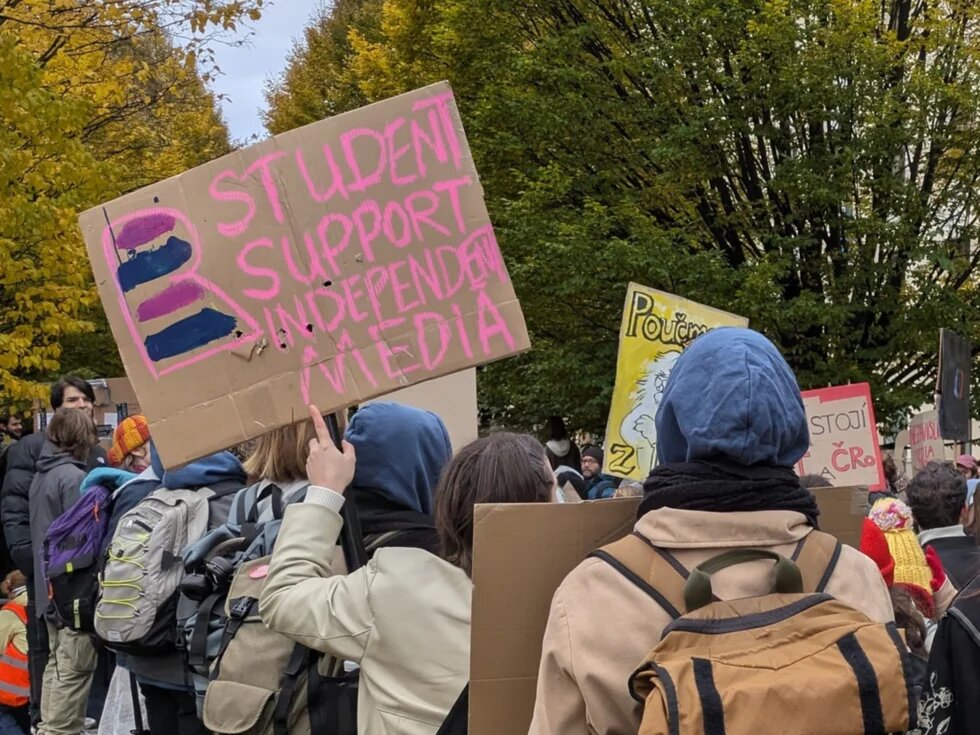
Meanwhile, a STEM/MARK survey conducted for ČT at the end of October shows that while the issue of licence fees divides Czech society, there is broad agreement that public service media should remain outside the control of either the state or a private owner (68%). Opinions differ on the funding model: one-third favour retaining licence fees, while 54% prefer transferring funding to the state budget, yet only 23% support the proposed legislation in its current form. Nearly four-fifths of respondents said they consider public events and protests in support of Czech Television and Czech Radio to be legitimate, or view them neutrally. These findings suggest that support for changing the funding model should not be conflated with support for the current proposal and point to the need for credible safeguards for broadcasters’ independence.
Prime Minister Andrej Babiš continues to insist that the Government will keep its promise to abolish licence fees, although he has now acknowledged the need to discuss their replacement. At this stage, the complete withdrawal of the reform appears unlikely: the governing coalition has made abolishing licence fees a political commitment and invested considerable political capital in the proposal. Nevertheless, the scale of public opposition has significantly raised the political costs of pushing the legislation through unchanged, forcing the coalition to slow the process and engage in debate. The outcome of this confrontation has implications beyond the funding model itself, therefore. ČT and ČRo have long been regarded as a public service media success story in Central and Eastern Europe. The current reform tests both their resilience and civil society’s willingness to defend them and resist such opaque, rushed legislative processes.
The views and opinions in this article do not necessarily reflect those of the Heinrich-Böll-Stiftung Prague.


